WEIXIAN Unit 79 Neutralization and Dioxane Stripping Introduction and Technologies Comparison
Oct 30, 2026
1. System Description
WEIXIAN's Unit 79 integrates neutralization, cooling, degassing, and dioxane stripping into a single continuous process. The core principle involves mixing acid and base raw materials with a 10-fold (1000%) recycle of cooled, degassed, and dioxane-stripped SLES in the Neutralization Reactor (79MX1). The reaction generates only a slight temperature rise (3–5°C), ensuring stable pH and light product color. The Neutralization Reactor maintains a constant outlet pressure of 0.3 bar, enabling stable feeding of acid, base, buffer, and bleaching agent.
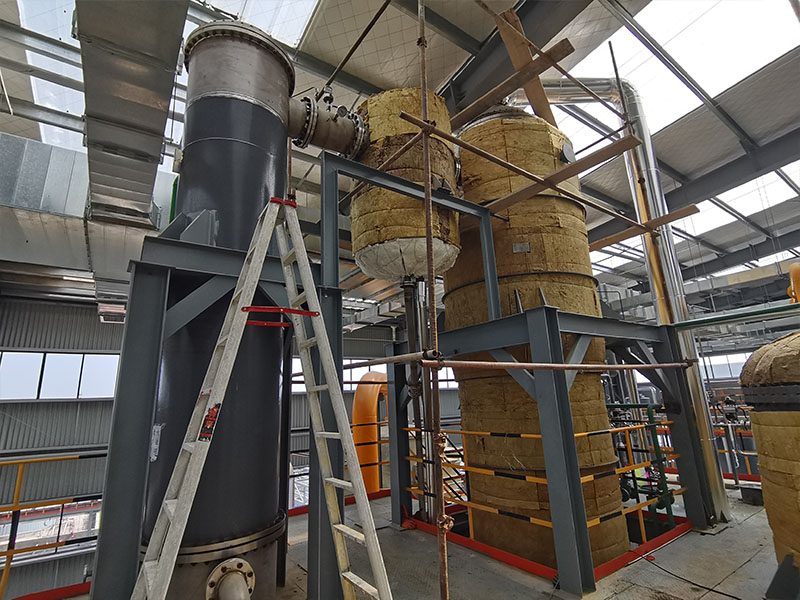
The neutralized material enters the Stripping Tower (79T1), where it undergoes moisture evaporation, cooling, dioxane removal, and degassing under vacuum at 45–55°C. The tower contains no rotating equipment, and the material does not contact the inner wall, eliminating the need for maintenance, electric power, and cleaning. The residence time from Neutralization Reactor to Stripping Tower is sufficient for bleaching.
At the tower bottom, the treated material—now at 10 times the production capacity—is returned to 79MX1 via the SLES Recycling Pump (79P6), forming the main process loop: 79MX1 → 79T1 → 79P6. Product is discharged through the SLES Transferring Pump (79P7). Low-temperature steam is condensed, and the condensate containing dioxane (200 ppm, 75 kg/t SLES) is discharged. The Recycling Vacuum Pump (79P9) maintains the vacuum condition.
Subsidiary materials are precisely controlled: pure water and liquid caustic soda via mass flow meters and adjusting valves (with separate small and large valves for high- and low-concentration products, respectively), and buffer and bleaching agents via metering pumps. The system also produces AOS by adopting a bypass of the 79MX1 outlet; during AOS production, the vacuum pump is disengaged and the neutralized material proceeds directly to sultone hydrolysis via 79P7.
Operating under vacuum with pH ≤ 7.5 and a minimal temperature rise (material temperature ≤ 55°C), the system achieves optimal conditions for SLES ammonium salt production.
2. Comparison of SLES Neutralization Technologies
Four continuous neutralization technologies are currently available: (1) Double-step Neutralization (Ballestra), (2) Pump Type Neutralization (Chemithon), (3) Vacuum Neutralization (Ballestra), and (4) Neutralization and Dioxane Stripping (WEIXIAN).
The first two are conventional technologies that use high-speed shearing mixers to thoroughly blend feed with refluxed SLES, then remove neutralization heat via a recycle pump and cooler. Approximately 15 times (1500%) of the yield is returned to the mixing equipment as reflux, with one time going to product handling. Pump type neutralization proceeds directly to product handling, whereas double-step neutralization first passes through a second mixing stage. Both achieve temperature rises below 5°C and stable pH through mass-flow SLES reflux. Practical experience shows that, provided SO₃ concentration, free oil content, and especially sulfate residence time remain constant, indicators such as pH stability and dioxane content (very high) are equivalent across these technologies.
The latter two are multi-functional technologies integrating neutralization mixing, cooling, vacuum dioxane stripping, and vacuum degassing. Vacuum neutralization transfers reaction materials to a wiped-film evaporator where reaction, moisture evaporation, dioxane removal, and degassing occur simultaneously under vacuum. However, the wiped-film evaporator has limited evaporation area, high cost, and high motor power consumption, and SLES feed quantity is restricted. For a 3.8 t/h SLES plant, the valid evaporation area is 10 m² without SLES reflux; with 2–3 times reflux, 30 m² is required. Vacuum neutralization lacks SLES reflux, causing excessive temperature rise (material temperature > 85°C) and unstable pH.
WEIXIAN's neutralization and dioxane stripping technology mixes reaction materials with 10 times (1000%) SLES reflux in the neutralization reaction reactor, controlling temperature rise at 3–5°C. The SLES then enters the stripping tower and disperses, with moisture evaporation and degassing conducted simultaneously under −0.09 to −0.095 MPa vacuum. This achieves neutralization, cooling, dioxane stripping, and degassing in one step, overcoming the high temperature rise, poor pH stability, and high power consumption of vacuum neutralization. Furthermore, it produces SLES with low dioxane content (guaranteed below 10 ppm; ≦5 ppm achievable) under higher SO₃ concentration (3%) and lower free oil content (1.2%). Low power consumption, low raw material unit consumption, and low dioxane content. The technology is also applicable to AOS and SLS neutralization.
For conventional neutralization technology, achieving dioxane content below 15 ppm requires SO₃ concentration of 2.3–2.5% and free oil content of 1.5–1.7%, resulting in 15 kWh more power consumption and 3–5 kg more organic raw material consumption per ton of 70% SLES.
3. Summary of Unit 79 Advantages
In SLES neutralization, cooling, dioxane stripping, and degassing, all parameters of WEIXIAN's Unit 79 outperform Vacuum Neutralization. With Unit 79, SO₃ content can be raised from 2.75% to 3.75% during SLES production while maintaining low dioxane and free oil content—enabling capacity increases of up to 40% and electric power unit consumption reductions of 40%, without requiring improved dry air quality.
Unit 79 combines neutralization, material cooling, degassing, and dioxane stripping into one process, producing low- and high-concentration sodium/ammonium salts of SLES/SLS as well as AOS.
The process flow is short and simple, ensuring stable and easy operation. The 79T1 stripping tower is static equipment with no motor or rotating parts, eliminating breakdown risk. Neutralization occurs in 79MX1 with large-volume slurry recycling, keeping temperature rise below 5°C and ensuring good, stable product color and pH.
The system utilizes neutralization heat to evaporate moisture and dioxane under vacuum at low temperature, requiring no additional heater heat.
By achieving low dioxane content, low unit electric power consumption, and low organic raw material unit consumption, it represents the best and most popular technology in the international competition.