blog
  • WEIXIAN Unit 79 Neutralization and Dioxane Stripping Introduction and Technologies Comparison
    WEIXIAN Unit 79 Neutralization and Dioxane Stripping Introduction and Technologies Comparison Oct 30, 2026
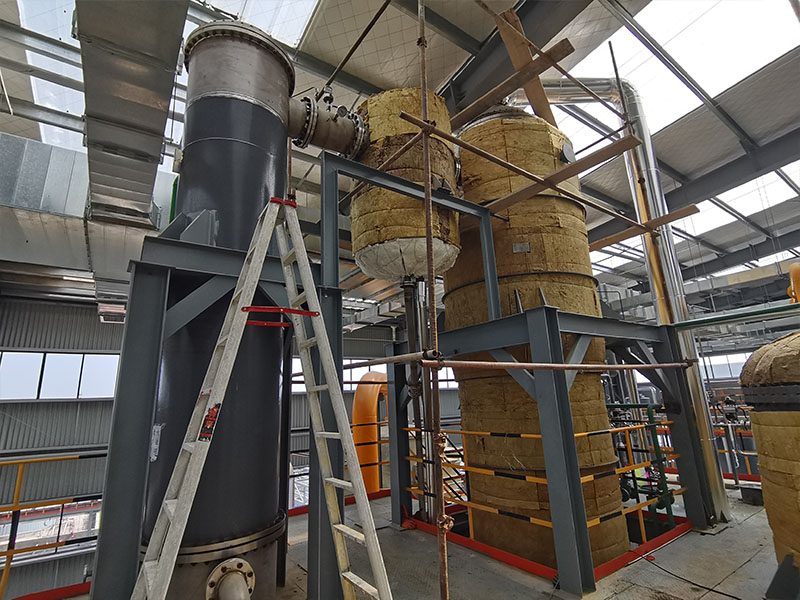
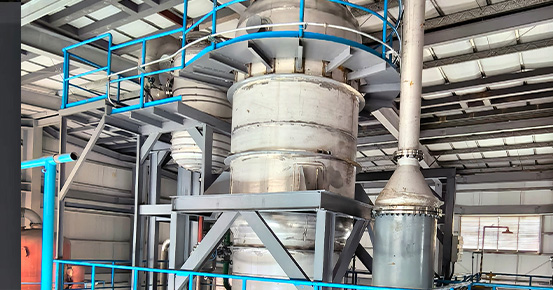
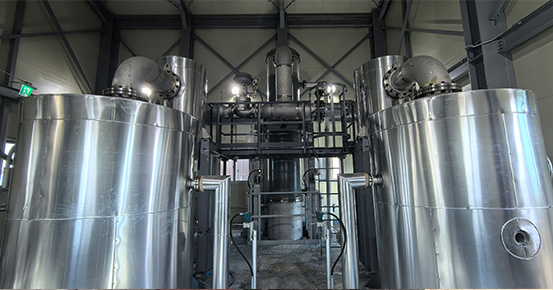
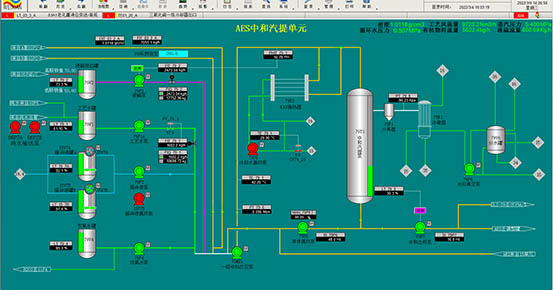
    1. System Description   WEIXIAN's Unit 79 integrates neutralization, cooling, degassing, and dioxane stripping into a single continuous process. The core principle involves mixing acid and base raw materials with a 10-fold (1000%) recycle of cooled, degassed, and dioxane-stripped SLES in the Neutralization Reactor (79MX1). The reaction generates only a slight temperature rise (3–5°C), ensuring stable pH and light product color. The Neutralization Reactor maintains a constant outlet pressure of 0.3 bar, enabling stable feeding of acid, base, buffer, and bleaching agent.   The neutralized material enters the Stripping Tower (79T1), where it undergoes moisture evaporation, cooling, dioxane removal, and degassing under vacuum at 45–55°C. The tower contains no rotating equipment, and the material does not contact the inner wall, eliminating the need for maintenance, electric power, and cleaning. The residence time from Neutralization Reactor to Stripping Tower is sufficient for bleaching.   At the tower bottom, the treated material—now at 10 times the production capacity—is returned to 79MX1 via the SLES Recycling Pump (79P6), forming the main process loop: 79MX1 → 79T1 → 79P6. Product is discharged through the SLES Transferring Pump (79P7). Low-temperature steam is condensed, and the condensate containing dioxane (200 ppm, 75 kg/t SLES) is discharged. The Recycling Vacuum Pump (79P9) maintains the vacuum condition.   Subsidiary materials are precisely controlled: pure water and liquid caustic soda via mass flow meters and adjusting valves (with separate small and large valves for high- and low-concentration products, respectively), and buffer and bleaching agents via metering pumps. The system also produces AOS by adopting a bypass of the 79MX1 outlet; during AOS production, the vacuum pump is disengaged and the neutralized material proceeds directly to sultone hydrolysis via 79P7.   Operating under vacuum with pH ≤ 7.5 and a minimal temperature rise (material temperature ≤ 55°C), the system achieves optimal conditions for SLES ammonium salt production.   2. Comparison of SLES Neutralization Technologies   Four continuous neutralization technologies are currently available: (1) Double-step Neutralization (Ballestra), (2) Pump Type Neutralization (Chemithon), (3) Vacuum Neutralization (Ballestra), and (4) Neutralization and Dioxane Stripping (WEIXIAN). The first two are conventional technologies that use high-speed shearing mixers to thoroughly blend feed with refluxed SLES, then remove neutralization heat via a recycle pump and cooler. Approximately 15 times (1500%) of the yield is returned to the mixing equipment as reflux, with one time going to product handling. Pump type neutralization proceeds directly to product handling, whereas double-step neutralization first passes through a second mixing stage. Both achieve temperature rises below 5°C and stable pH through mass-flow SLES reflux. Practical experience shows that, provided SO₃ concentration, free oil content, and especially sulfate residence time remain constant, indicators such as pH stability and dioxane content (very high) are equivalent across these technologies.   The latter two are multi-functional technologies integrating neutralization mixing, cooling, vacuum dioxane stripping, and vacuum degassing. Vacuum neutralization transfers reaction materials to a wiped-film evaporator where reaction, moisture evaporation, dioxane removal, and degassing occur simultaneously under vacuum. However, the wiped-film evaporator has limited evaporation area, high cost, and high motor power consumption, and SLES feed quantity is restricted. For a 3.8 t/h SLES plant, the valid evaporation area is 10 m² without SLES reflux; with 2–3 times reflux, 30 m² is required. Vacuum neutralization lacks SLES reflux, causing excessive temperature rise (material temperature > 85°C) and unstable pH.   WEIXIAN's neutralization and dioxane stripping technology mixes reaction materials with 10 times (1000%) SLES reflux in the neutralization reaction reactor, controlling temperature rise at 3–5°C. The SLES then enters the stripping tower and disperses, with moisture evaporation and degassing conducted simultaneously under −0.09 to −0.095 MPa vacuum. This achieves neutralization, cooling, dioxane stripping, and degassing in one step, overcoming the high temperature rise, poor pH stability, and high power consumption of vacuum neutralization. Furthermore, it produces SLES with low dioxane content (guaranteed below 10 ppm; ≦5 ppm achievable) under higher SO₃ concentration (3%) and lower free oil content (1.2%). Low power consumption, low raw material unit consumption, and low dioxane content. The technology is also applicable to AOS and SLS neutralization.   For conventional neutralization technology, achieving dioxane content below 15 ppm requires SO₃ concentration of 2.3–2.5% and free oil content of 1.5–1.7%, resulting in 15 kWh more power consumption and 3–5 kg more organic raw material consumption per ton of 70% SLES.   3. Summary of Unit 79 Advantages   In SLES neutralization, cooling, dioxane stripping, and degassing, all parameters of WEIXIAN's Unit 79 outperform Vacuum Neutralization. With Unit 79, SO₃ content can be raised from 2.75% to 3.75% during SLES production while maintaining low dioxane and free oil content—enabling capacity increases of up to 40% and electric power unit consumption reductions of 40%, without requiring improved dry air quality.   Unit 79 combines neutralization, material cooling, degassing, and dioxane stripping into one process, producing low- and high-concentration sodium/ammonium salts of SLES/SLS as well as AOS.    The process flow is short and simple, ensuring stable and easy operation. The 79T1 stripping tower is static equipment with no motor or rotating parts, eliminating breakdown risk. Neutralization occurs in 79MX1 with large-volume slurry recycling, keeping temperature rise below 5°C and ensuring good, stable product color and pH.  The system utilizes neutralization heat to evaporate moisture and dioxane under vacuum at low temperature, requiring no additional heater heat.    By achieving low dioxane content, low unit electric power consumption, and low organic raw material unit consumption, it represents the best and most popular technology in the international competition.
  • WEIXIAN’s Unit 79 – Ultra Low Dioxane SLES, Made Simple
    WEIXIAN’s Unit 79 – Ultra Low Dioxane SLES, Made Simple Sep 09, 2026
    WEIXIAN has just commissioned another Unit 79 Neutralization and Dioxane Stripping system – this time in Europe. The results? 2 ppm dioxane, a 90% removal rate – significantly exceeding contract guarantees. The client’s team was highly impressed with both the performance and our on site support.   Earlier this year, we delivered a system in South Korea achieving 1 ppm dioxane. Two continents, two successes. Unit 79 is proven, reproducible, and ready.   What sets Unit 79 apart?   Easy to operate – Intuitive automation, quick start up, minimal training. The European team was running routine operations within days.    Low maintenance – Robust design, less fouling, fewer spare parts. Longer runs, less downtime.    Energy efficient – Optimised heat integration cuts steam and power consumption per tonne – a lasting cost advantage.   Over 40% excess capacity – Delivers well above nameplate rating without compromising dioxane removal or product quality, giving you the flexibility to capture peak season demand with the same investment.   For premium SLES producers facing tightening dioxane limits, Unit 79 offers a field proven answer: consistent sub 2 ppm performance, stable long term operation, and lower running costs – all in one package.   WEIXIAN – Unit 79. Proven in Europe. Proven in Asia. Ready for you.  
  • WEIXIAN Introduces A World First in Continuous Air Drying for Sulfonation/sulfation
    WEIXIAN Introduces A World First in Continuous Air Drying for Sulfonation/sulfation Sep 09, 2026
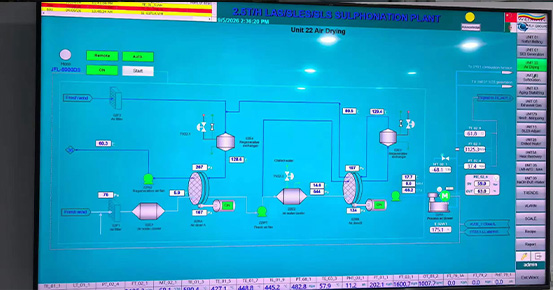
    For decades, dual tank drying systems have been the accepted standard in sulfonation/sulfation plants – two vessels cycling between adsorption and regeneration every eight hours, with all the inherent switching shocks, dew point swings, and operator attention that come with them. WEIXIAN asked: Why cycle at all? Unit 22 (full name: Unit 22 Rotor Silica Gel Bed Air Drying) is our answer – a single, continuously rotating silica gel rotor that eliminates the switchover entirely. This is a world first technology, purpose built to replace the intermittent drying paradigm that the industry has long accepted as unavoidable.   The Upgrade in Brief   8,000 hours/year continuous operation – no 8 hour changeover cycles, no regeneration induced production stops or turndowns.   Stable air flow and temperature – no switching transients to disturb the process.   Constant dew point at –65 °C ± 3 °C – no drift, no spikes, no surprises.    Consistent product quality – fewer side reactions, less tar, tighter specifications batch after batch.   Simpler operations – fewer valves, no complex timing logic, near zero daily intervention.    Lower power consumption – optimised regeneration profile and reduced pressure drop cut electrical costs.   Why It Matters for Your Plant   Uptime – Your reactor sees exactly the same dry air at 8 a.m. and 8 p.m.   Product purity – Especially critical for high grade LABSA and SLES.   Operations – Your team focuses on output, not dryer babysitting.   Energy – Directly improves your per tonne variable cost.   Retrofit Ready, Investment Smart – Unit 22 is engineered as a direct replacement for existing dual tank layouts, sharing a similar footprint and connection points to minimise civil work during revamps. For new plants, it simplifies the entire drying skid. The capital cost is competitive, and the payback – from energy savings, maintenance reduction, and yield improvements – is remarkably short.   The Bottom Line – Dual tank drying is mature, but mature doesn't mean optimal. Unit 22 takes air drying from intermittent to truly continuous – something no one in the industry has achieved before. If you're planning a new sulfonation line or upgrading an old one, let's talk about this genuine step change.  
  • Ultra-Low Dioxane System Achieves Successful Commissioning
    Ultra-Low Dioxane System Achieves Successful Commissioning Aug 14, 2026
    In recent years, Weixian has maintained a strong focus on ultra-low dioxane technology. Building on the previous Unit 79 Neutralization and Dioxane Stripping process, Weixian has newly developed the Unit 89 Dioxane Multi-stage Stripping process, which achieves a dioxane removal rate of 65% to 99%, depending on specific needs. With this innovative technology, a dioxane content of less than 1 ppm can be reliably achieved, regardless of the raw material’s EO number or initial dioxane level.   In April 2026, Weixian engineers have successfully commissioned an ultra-low dioxane system in South Korea.    Through meticulous optimization of operating parameters, the system achieved an impressive 88.7% removal efficiency, reducing dioxane concentration from 9.88 ppm to 1.13 ppm. The client is highly satisfied with the results, and further reduction in dioxane levels is achievable upon request.   This breakthrough allows any sulphation plant to comply with the strictest SLES dioxane limits demanded by high-end markets, while keeping costs relatively low.      
  • WEIXIAN Plate ESP: Proven Design, Superior Collection Efficiency
    WEIXIAN Plate ESP: Proven Design, Superior Collection Efficiency Jul 30, 2026
    Disc-Type ESP is currently the preferred choice in the sulphonation industry, with over 80% market share and SO₃/acid mist removal efficiency up to 99%.   Wire-Type ESP requires 6–8 suspension rods through the anode tube to the lower support frame, which do not contribute to demisting, causing 3–4% tail gas bypass and limiting acid mist removal to ≤97%.   Compared with wire-type, the disc-type cathode tubes offer much higher reliability, eliminating downtime caused by broken cathode wires and avoiding personnel entry for maintenance. With a service life over 20 years versus three years for wire-type, disc-type cathode tubes greatly reduce maintenance costs.  
  • Improvements of Tube Plate Sealing for Ultra-Large Sulfonator
    Improvements of Tube Plate Sealing for Ultra-Large Sulfonator Jul 17, 2026
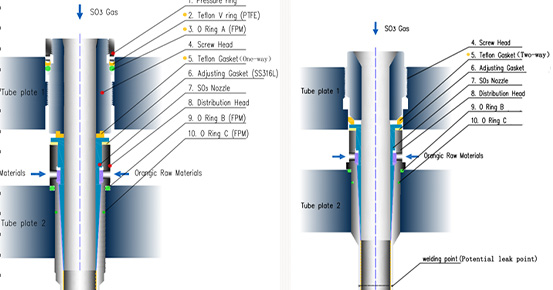
    Weixian Technology has improved ultra-large sulphonators (178-240 tubes) and achieved successful operation and wide deployment:   1.Screw Head: As shown in Fig.1, gaskets (Items 1–3) block SO₃, preventing rust or seizure between Tube plate 1 and the screw. Item 5 is a one-way gasket, needing under half the torque of imported equipment, significantly reducing tube plate 1 deformation.   (Fig 1:WEIXIAN Sulphonator head diagram) (Fig 2: Imported / Copy Sulphonator Head Diagram)   2. Increased Distribution Chamber Height: With the improved screw head sealing, the organic chamber height can be increased by 25% or more, minimizing the flow pressure difference between center and edge for uniform distribution, especially in ultra-large sulphonators with 178/192 tubes or more. Imported sulphonators, limited by the dual-direction gasket (Item 5, Fig.2), are fixed at 32 mm, causing higher pressure differences as size increases.   3. Pressurized Water Return: Improved screw head sealing increases clamping force on sealing ring (Item 9, Fig.1), allowing shell-side cooling water above 0.5 MPa and enabling pressurized water return, eliminating a high-power circulation pump. Imported design (Fig.2, Item 9) has a limiting block, restricting shell-side pressure to ≤0.15 MPa and preventing pressurized return.   Weixian Sulphonator Assembly and Disassembly Guidelines   (A) tube plate Removal Precautions 1.      Loosen screw heads (Item 4, Fig.1) after slightly loosening the pressure ring (Item 1), then remove all screw heads. 2.      Once screw heads are removed, tube plate 1’s reaction force is gone; central locating rods (1–3) can be lightly unscrewed and removed. 3.      Normally, tube plate 1 is removed every 1–2 years. To clean the feed chamber or nozzles, remove only the screws; debris can be vacuumed out. 4.      Screw head seals (Items 1–3) can be reused; no replacement needed every time.   (B) tube plate 1 and screw head Installation 1.      Position the tube plates 1 and 2 using the three locating tie rods per tube layout; tighten nuts. 2.      Install central rods (1–3) with a 400 mm (16”) torque wrench, max 80 kN, tightening evenly; do not use extra leverage. 3.      Tighten other tie rod bolts sequentially, finishing diagonally to avoid uneven stress and edge leaks. Check central rods lightly. 4.      Install screw heads: loosen pressure ring slightly, tighten screws with torque wrench (35–45 kN, click indicates correct), ensure even load, then tighten compression ring.   (C) Leak and Pressure Test 1.      Do not test shell-side leaks with screw heads loose; fully tighten tie rods and screw heads first. 2.      During LAB circulation, vent tube plate 1 chamber, check each screw’s PTFE gasket (Item 5) and ring with flashlight or dry paper; ensure no leaks.        
  • WEIXIAN Breakthrough in Ultra-Large Sulphonator Technology
    WEIXIAN Breakthrough in Ultra-Large Sulphonator Technology Jun 12, 2026
    In 2022 and 2025, the 7.5 t/h LABSA, AES, and AOS plants in Meishan and Southeast Asia were successfully commissioned. The design, complete units, technical support, training, and commissioning are provided by WEIXIAN.   At the beginning of 2026, a 7.5 t/h sulphonator supplied by Weixian was successfully commissioned in Shanghai. The equipment features a triple-center rod design and a novel tube sheet + threaded compression seal, ensuring zero leakage.  Two 8 t/h Sulphonic Acid and AES Plants in Southeast Asia and West Asia have been delivered and are now under installation. The plants use Weixian's proprietary ultra-low dioxane technology to produce AES (70%) with a stable dioxane content below 3 ppm.                  192-Tube New Triple-Center Rod Sulphonator      Weixian Technology Leads in Ultra-Large Membrane Sulphonators (178-240 Tubes) with Advanced Technology and Proven Global Experience   Reliable Sealing Design: PTFE and FKM Enhanced Threaded Structure Prevents SO₃ Leakage and Corrosion, Offering Higher Reliability than Italian Equipment (Fig. 1 & 2)     50% Reduction in Tube Sheet Deformation: The Improved PTFE Flat Seal Provides More Stable Sealing, Minimizes Thrust on the Tube Sheet, Prevents Organic Leakage, and Significantly Extends the Operating Cycle of the Sulphonator.   Increased Distribution Chamber Height: Tube Sheets 1, 2, and 3 are 16% thicker than those of imported sulphonators, and the organic distribution chamber is increased by 25% in height. This design significantly reduces tube sheet deformation in large sulphonators (6, 8, 10 t/h, etc.) and ensures better central distribution of organic material, enabling stable and efficient operation of 8 t/h and 10 t/h units.   Optimized Reactor Tube Welding: The joint between the reactor tube and distribution head is moved upward to avoid the initial reaction zone, and the butt weld is replaced with a fillet weld, creating a seamless inner wall. Compared with imported sulphonators, this eliminates minor leakage and greatly improves reliability.   Pressurized Water Return: Tube Sheet 3 uses one FKM O-ring and three PTFE gaskets for shell and tube side sealing, ensuring Weixian sulphonators are completely leak-free and can handle pressurized water up to 0.5 MPa (tested at 0.6 MPa).   Precision Component Optimization: Adjusting the dimensions and angles of reactor tubes, distribution head, and nozzles increases organic flow pressure drop by 13.3%, enhancing self-balancing compared with imported sulphonators. This maintains more stable organic distribution, reduces dioxane during AEO sulfation, and significantly extends the alpha-olefin sulfonation operating cycle.   Reactor Tube Special Manufacturing: Tubes are made using high-precision cold rolling and oxygen-free annealing without post-polishing, achieving uniform inner and outer wall roughness of Ra 0.4 across each tube. This ensures that, under the same process and quality conditions, AES dioxane content is significantly lower than in imported units.   ( 192-Tube Sulphonator As-Built Photo)   WEIXIAN Project list 5-8T/HR reactor(Partial) Location Capx (kg/h) Note Built year Turkey 8000 Turnkey 8TPH plant of LAS,AES,192-tube reactor Ongoing Southeast Asia 8000 Turnkey 8TPH plant of LAS,AES,SLS,192-tube reactor Ongoing Resun 7500 178-Tube 7.5TPH Reactor 2026.4 Jintung 5000 120-Tube 5TPH Reactor 2026.3 Southeast Asia 7500 Turnkey plant of LAS,AES,180-tube reactor 2025.3 RuiFeng 5000 Turnkey plant of HABSA,120-tube reactor 2024.5 Sinolight 5000 Revamping,WEIXIAN 120-Tube reactor to replace old 3.8T/H reactor 2023.9 Shengtai 6000 6TPH LAS,AES Plant, 144-Tube reactor 2022.9 Pakistan 1 6000 Turnkey 6TPH plant of LAS, 144-Tube reactor 2022.6 Huimiao 7500 Turnkey 7.5TPH plant of LAS、AES、AOS、K12,180-Tube reactor 2022.2 Turkey 6000 Turnkey 6TPH plant of LAS、AES, 144-Tube reactor 2022.2 Pakistan 2 6000 Turnkey 6TPH plant of LAS、AES, 144-Tube reactor 2021.2 India 6000 Turnkey 6TPH plant of LAS、AES, 144-Tube reactor 2021.11 ZZY 4*5000 4 sets of 5TPH 120-Tube Reactor 2021.03 Sinolight 6000 Turnkey 6TPH plant of LAS、AES, 144-Tube reactor 2021.6 Huimiao 6000+3800 Turnkey 6TPH+3.8TPH plant of LAS、AES, 144-Tube+90-Tube reactor 2020.5 Resun 2*6000 Revamping,WEIXIAN 144-Tube reactor to replace old reactor 2020.4 Huimiao 6000 Turnkey 6TPH plant of LAS、AES、AOS、SLS 144-Tube reactor 2019.1
  • WEIXIAN Sulfonator Introduction
    WEIXIAN Sulfonator Introduction Jun 26, 2024
      Sulphonation Reactor: Sulfonator is the core equipment of a sulphonation plant, WEIXIAN Reactor adopts multi-tube falling film type. The organic raw materials entrances are between the Tube-sheet 1&2, the organic raw materials in the reaction tube form a uniform film, and reacts with SO3 gas (2.5- 7%). The reaction emits a large amount of heat which is removed by heat exchange of chilling water or cooling water in the shell process.   There are currently mainly 5 types of organic raw materials, which are: 1.  LAB/ alkyl benzene for LABSA 2.  AEO1, AEO2 or AEO3/ Fatty alcohol ether for SLES- 1EO/2EO/3EO 3.  AO/ α olefin for AOS 4.  FA/ fatty alcohol for SLS 5.  HAB/heavy alkyl benzene for HABSA The capacity range of WEIXIAN sulphonators is from 1 tube to 240 tubes (1 - 10t/h). So far, WEIXIAN has supplied hundreds reactors, including two world’s largest 7.5t/h 180-tube reactors.  The technical advantages of WEIXIAN sulfonator: Ø    The organic material distribution system 1.  The reactor calibration can easily reach ±1.5% deviation, which makes the first start up much simpler and results in better product quality. 2.  The distribution heads and nozzles are machined in a single clamping process in a CNC machining center to ensure that the tolerance of the main dimensions reaches ±0.01mm. Ø    High finish degree of each reaction tube surface Special manufacturing processes are applied, the reaction tubes are processed under a 1040℃ vacuum condition to remove inter- molecular stress after high-precision cold rolling , which makes sure the inner and outer surfaces’ finish degree of each reaction tube reaches Level Ra0.4 (like mirror) with high consistency, benefited from perfect surface finish, consistent molar ratio of the entire reaction can be ensured and side reaction can be reduced greatly, this is crucial in regards of minimizing dioxane content in SLES and reducing the organic acid content in exhaust gas. In addition, the tolerance of the inner diameter and outer diameter of the reaction tube is controlled within the range of ±0.04mm. Ø  Welding points and Pre-factory testing The welding points between the Reaction Tube and the Distribution Head are moved up to skip the reaction initial part, and butt welding is changed to fillet welding. Therefore there is no weld on the entire 6-meter Reaction Tube, shallow leakage at reaction initial part can be avoided, and the reliability is greatly improved. Each reaction tube is subjected to 0.6Mpa water pressure test and endoscopic probe to check the weld molding and inner tube precision before leaving the factory. Ø  Concentricity of the three tube sheets Three pieces of tube sheets must be machined with the same coordinates in the machining center. The concentricity tolerance of the processed pipe holes reaches ±0.01mm. After the completion of manufacturing, the three pieces of tube sheets are stacked and fixed together according to the installation position, and checked hole by hole with the concentricity deviation of less than ±0.02 inspection mandrel. Ø  Reliability of multiple seals in the sulfonator 1.    Cooling/chilling water sealing in shell process: cooling/chilling water is fed into two inlets and discharged through three outlets after heat exchanging; the upper section is strictly sealed to ensure that the upper section circulates the chilled water (15°C) separately without leakage. This is especially important in the production of AOS. 2.     The head of sulfonator adopts two-way sealing of SO3 sealing and organic material sealing: the compression screw head of the tube sheet 1 adopts a combination of screw head + three combination gaskets to form a reliable two-way sealing, which realizes 100% reliable isolation of oleum and elimination of rusting and leakage. 3.      Distribution head and shell process cooling water sealing: With the use of new sealing structure greatly improves the pressure resistance of the shell process, shell process test pressure reaches 0.6Mpa or more. All sealing parts are made of special fluorine rubber O-ring, with 100% sealing efficiency and lifetime without replacement. 4.      Lower section of reaction tube and shell process cooling water sealing: adopts Viton O-ring sealing, 100% sealing efficiency, lifetime without replacement.   Other advantages: 1.      Long extended washing interval: continuous production of LABSA can reach more than 40 days, more than 3 months for SLES production and more than 25 days for AOS production. 2.      Easy calibration of reactor: ±1.5% deviation of flow rate at the first start-up, and the range of gasket replacement is 1.8-2.2mm (base thickness is 2mm), which ensures the quality of sulfonated products and extends the cleaning cycle of the reactor. 3.     Yield Flexibility: Capacity adjustment range 55% ~ 115% for LABSA production; Capacity adjustment range 80% ~ 140% for SLES 70% production.    
  • Weixian Unit 79 Introduction and Different Neutralization System Comparison
    Weixian Unit 79 Introduction and Different Neutralization System Comparison Jul 06, 2023
    1. Description Of Weixian’s Unit 79   1.1 The principle of WEIXIAN’s Unit 79 Neutralization and Dioxane Stripping is that acid and base raw materials alone with 10 times (1000%) cooled, degassed and dioxane stripped SLES to mix and react in the Neutralization Reactor (79MX1). In the reaction, a small quantity of heat is generated which causes a very sight temperature rise (3-5℃). That makes sure the pH value of neutralizing materials is stable and color is light. Meanwhile, the Neutralization Reactor (79MX1) keeps outlet pressure constantly at 0.3 bar, makes the feeding of acid, base, buffer and bleaching agent stable.   1.2 The material that exit from Neutralization Reactor (79MX1) enters the Stripping Tower (79T1). Under vacuum and low temperature condition (45-55℃), the material is evaporating moisture, cooling down, removing dioxane and degassing. Because there is no rotating equipment, and material doesn’t contact with the inner wall of Stripping Tower; maintenance, electric power and cleaning is not required. Also, the duration that material pass from Neutralization Reactor to Stripping Tower is enough for bleaching.   1.3 At the bottom of Stripping Tower (79T1), the material’s (has been cooled, degassed and dioxane stripped) quantity is 10 times of capacity, through 79P6 SLES Recycling pump, goes to Neutralization Reactor (79MX1). So that 79MX1-79T1-79P6 forms the main process line of Unit 79.   1.4 The material (has been cooled, degassed and dioxane stripped) goes through SLES Transferring Pump (79P7) and get discharged from the system. Low temperature steam is condensated by condenser, and the condensated water (contains dioxane) is discharged (200ppm, 75kg/t SLES). The Recycling Vacuum Pump (79P9) creates the vacuum condition.   1.5 Subsidiary materials feeding: the pure water is controlled by a mass flow meter and a adjusting valve (the small adjusting valve is for producing high-concentration product, big adjusting valve is for low-concentration product). The liquid caustic soda is also controlled by a mass flow meter and adjusting valve; buffer and bleaching agents are controlled by metering pumps.   1.6 This system also produces AOS by adopting the bypass of Neutralization Reactor (79MX1) outlet. While producing AOS, Vacuum Pump doesn’t work, the neutralized material doesn’t need to get cooled down, it goes to sultone hydrolysis by Material Pump 79P7.   1.7 The system is under vacuum condition and pH value ≤ 7.5, the temperature rise of neutralization reaction is very less (material temperature ≤ 55℃), and achieves the best producing requirements of SLES ammonium salt.   2. Different SLES Neutralization Technology Comparison   At present, there are four different continuous neutralization technologies exist: 1. Double-step Neutralization of Italian technology; 2. Pump Type Neutralization of American technology ; 3.Vacuum Neutralization of Italian technology and 4. Neutralization and Dioxane Stripping of WEIXIAN.   The former two types are common neutralization technologies, both are using a high-speed shearing mixing equipment to mix the feeding and re-fluent SLES fully, then through a SLES recycle pump and a cooler to remove heat of neutralization. After that, 15 times (1500%) of yield back to neutralization mixing equipment to re-flux, 1 time of yield to product handling. The difference between these two types is: pump type neutralization goes to product handling directly. However, double-step neutralization first go to 2nd mixing equipment to remix, then to product handling. The advantage of these two types is both have a mass flow of SLES re-flux, make the temperature rise lower than 5℃ and pH value stable. According to practical experiences, as long as the SO3 concentration, free oil content and especially the sulphate staying time keep the same, the various indicators will be all the same, such as pH stability and dioxane content.   The latter two types are both multi-function neutralization technologies, integrating neutralization mixing, neutralization cooling, vacuum dioxane stripping and vacuum degassing.   The vacuum neutralization transfers the reaction materials to wiped-film evaporator in which reaction take place. Simultaneously, moisture evaporating, dioxane removing and degassing are conducting under vacuum condition. This technology adopts one wiped-film evaporator for neutralization mixing and moisture evaporation, and the wiped-film evaporator has a limited evaporation area. It is featured in high cost and high motor power consumption and the feeding quantity of SLES is limited. Generally, for a 3.8t/h SLES plant, the valid evaporation area is 10㎡ (without SLES re-flux). If it has 2-3 times re-flux, the valid evaporation area need to achieve 30㎡. Regarding this type of equipment, not only the processing consideration, but also cost and power consumption should be big problems. The vacuum neutralization doesn't has SLES reflux, it will cause too much temperature rise, the material temperature would be more than 85℃ and lead to pH value unstable.    The technology of WEIXIAN’s neutralization and dioxane stripping is mixing reaction material in neutralization reaction pump or mixer fully with 10 times (1000%) SLES re-flux, the temperature rise is controlled at about 3-5℃. Then SLES goes to stripping tower and disperse in it. Simultaneously, evaporate the moisture and degas under -0.09/-0.095 mpa vacuum condition. It achieves neutralizing, cooling, dioxane stripping and degassing at same time, and it overcomes the high temperature rise, poor pH stability and high power consumption of the vacuum neutralization technology. Furthermore, it produces SLES with low dioxane content (guaranteed lower than 10ppm, 1-5ppm is achievable) under higher SO3 concentration (3%) and lower free oil content (1.2%), which means low power consumption, low raw material unit consumption and low dioxane content. WEIXIAN’s neutralization and dioxane stripping technology can be also used for neutralize AOS and SLS.   Regarding common neutralization technology, if the dioxane content achieves below 15ppm, the SO3 concentration would be at 2.3-2.5% and free oil content would be at 1.5-1.7%, which means 15 kWh more power consumption and 3-5 kg more organic raw material consumption for producing every ton of 70% SLES.   3. The advantage of Unit 79 summary   First, in regards of SLES neutralizing, cooling, dioxane stripping and degassing, all the parameters of WEIXIAN’s Unit 79 Neutralization and dioxane stripping is better than Ballestra’s Vacuum Neutralization. Second, with Unit 79, the SO3 content can be raised from 2.75% to 3.75% while sulphnation plant producing SLES, and dioxane and free oil content remaining low value. That means the capacity can be increased max 40%, electric power unit consumption can be decreased 40%, without the need of improving dry air quality.   WEIXIAN’s Unit 79 combines neutralizing, material cooling, degassing and dioxane stripping into one process; produces low/high concentrate sodium/ammonium salt of SLES/SLS, and AOS. Its process flow is short and simple, so that operation is stable and easy. 79T1 is static equipment, without motor or rotating parts, it doesn’t brake. Neutralization reaction take place in 79MX1, with large quantity of slurry recycling, rise of temperature is less than 5 ℃, product’s color and pH value is good and stable. It utilizes the heat of neutralization to evaporate moisture and dioxane under vacuum and low-temperature condition, extra heat from heaters is not required. By achieving low dioxane content, low unit electric power consumption, low organic raw material unit consumption and power consumption, it is the best technology among international competitors’. China Unit 79 Neutralization and Dioxane Stripping, Unit 79 Neutralization and Dioxane Stripping Supplier - njweixian.com
  • Unit 38 Scrubber Waste Water Oxidizing, Evaporating and Crystallizing
    Unit 38 Scrubber Waste Water Oxidizing, Evaporating and Crystallizing Jun 07, 2023
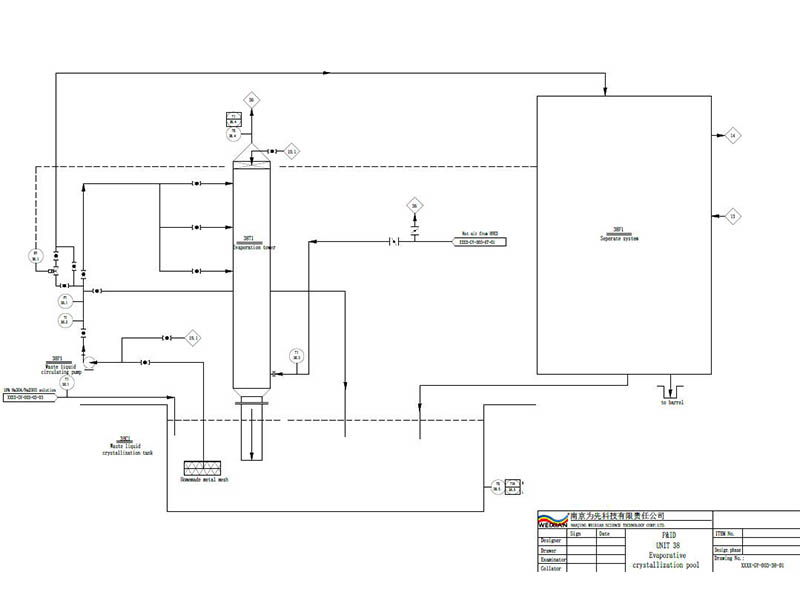
    Process description: The caustic soda waste water (10% solution) from sulphonation would be discharged into 38C1 crystallization tank. 38P1 recycling pump pumps the waste water into 38T1 evaporating tower to evaporate the moisture in that. The temperature would be controlled between 37-42℃, and concentration of salt between 29-33%; it crystallizes itself constantly.   The hot air (≥100℃) for evaporation is from third stage waste heat recovery (68E2/E2). It goes into 38T1 from the bottom to exchange heat with caustic soda liquid, evaporate moisture in it and also oxidize the NaSO3 in waste water to Na2SO4. Temperature of the air exiting 38T1 is controlled at 50℃. Na2SO4 crystal forms in 38C1, drawn by mud pump;then filter and pack. Filtrate goes back to 38C1 crystallization tank.   Unit 38 (caustic soda liquid oxidation, evaporation and crystallization) evaporates the moisture in 10% caustic soda solution, make the salt crystallizes in 38C1 (using the principle that Na2SO4 has different solubilities in difficult temperature. Also, waste heat air is balanced and surplus. Related link: China Unit 38 Waste Water Crystallization, Unit 38 Waste Water Crystallization Supplier - njweixian.com
  • The Advantage Between WEIXIAN's and Italian Sulfonator
    The Advantage Between WEIXIAN's and Italian Sulfonator May 26, 2023
      1. The sealing type of compression nut on reactor tube sheet 1:  increasing one V type Teflon gasket and Fluororubber O ring to isolate the leakage of SO3 and organic acid, so that no rust or leakage happen. The reliability is better than Italy reactor.(as below photo No.1 and 2) 2. The No.3 of photo change to flat Teflon gasket(Italy is two way gasket): This will bring better seal performance and can reduce 50% force to tube sheet 1, so that the transformation would greatly reduced and the organic material would not leak into reactor tube. The reactor washing times and operation period is highly improved.   3. Compared with Italian reactor, the thickness of WEIXIAN tube sheet 1/2/3 is 16% more and organic material chamber is 25% higher, that can make the transformation of tube sheet close to zero and distribution of organic material becomes more equal, this makes big capacity reactor be possible.   4. The welding point between reactor tube and distributor move up to avoid reaction segment and change from butt welding to fillet welding, so that there is no welding joint in reactor tube inside, compared with Italy reactor, WEIXIAN will not have leakage in this part, the reliability improved greatly.   5. The size and angle optimation of reactor tube, distributor and nozzle, make sure the organic material pressure drop 13% more when passing through gap , so the self balance performance is improved accordingly compared with Italy reactor, especially for α-olefin sulfonation.   6. The special manufacture process of reactor tube (without polishing) ,that can make sure the rough degree of tube inside and outside and each tube are highly consistency( Ra0.4), so the dioxane content will significantly superior to Italy’s when produce SLES.   7. One Fluororubber O ring and three Teflon gaskets were adopted between shell side and tube side of tube sheet 3, so WEIXIAN reactor will never leakage, and the cooling water can recycle under 0.5mpa pressure(pressure test is under 0.6mpa)   8. The material of reactor tube, distributor and nozzle are all booked from Bao steel (The biggest and best steel factory in china) and we ordered at least 5 tons one batch, so that the material source can traceable and the quality can be guaranteed.   9. WEIXIAN engineer will full time supervise the testing and assemble of reactor and its components. That will guarantee the fabrication and manufacturing quality.   Equipment Link: https://www.njweixian.com/sulphonationsulphation-reactor  
  • New technology: introduction of reaction heat utilizing for process air dehumidification
    New technology: introduction of reaction heat utilizing for process air dehumidification May 08, 2023
    The cooling, chilling and dehumidifying of process air in the traditional SO3 sulphonation process is to lower the process air to 40 C by recycling cooling water, then further reduce the temperature to 5 C by glycol chilling water solution; then the process air goes to sillica gel air dryers. In this case, the chilling water have to be generated by electrical chiller, for example, a 3.8t/h plant needs a 100KW chiller.   While, the new process Weixian newly developed is using the reaction heats of SO2 from outlet of sulfur furnace and SO3 from outlet of converter to generate steam directly. Minority of the steam goes to sulfur melting and the rest goes to lithium bromide absorption chiller for generating chilling water. The chilling water firstly lower the process air to 8 C and remove majority of the heat; then process air is lowered to 5 C by a 12-15KW electrical chiller. Or, directly lower the process air to 6 C by lithium bromide absorption chiller and directly go to sillica gel drying.   A 3.8t/h plant may save power 100KWH, one year saves about 800,000 kilowatt hour.   Detailed process as following: Air drying unit The fin-type heat exchanger is made out of SS304 and upper part heat exchanging area is 80%. The lithium bromide absorption chiller generates 3 C - 5 C chilling water and lower the process air to 8 C. The lower part of heat exchanging area is 20%, which uses the 1 C glycol solution generated from a electrical chiller to further decrease the the process air to 3 C - 5 C. In the winter, electrical chiller may not need to run. The lithium bromide absorption chiller is driven by 0.4 Mpa steam from waste heat recovery system, equipped with a chilling water tank and pump. The electrical chiller also equips with a glycol solution tank and pump.   Start-up pre-heating Start-up pre-heater is using 400KW electrical heater.   Sulfur combustion and conversion The tubular heat exchanger which in the sulfur furnace SO2 outlet and converter forth pass SO3 outlet have been replaced by fire tube heat exchanger for steam production from waste heat. The steam is generated directly and the efficient therefore has been increased 100%. For example, a 3.8t/h plant when sulfur feeding is 400kg/h, steam production can be 1.4t/h, 0.5 Mpa; when sulfur feeding is 280kg/h, steam production can be 1.0t/h, 0.5 Mpa.    Regeneration The first pass cooler of converter generates 400 C + hot air mix with the 125 C hot air from second SO3 cooler gets 150 C - 180 C hot air, which is used for sillica gel regeneration. The rest hot air is for generating hot water for heat tracing.    Recycling water station Flowrate of recycling water stays unchanged 400m3/h.    External steam supply When plant shut-down, Liquid sulfur tank needs 300kg/h 0.4 Mpa steam and other tanks need hot water for heat tracing.    Start-up pre-heating operation Start-up needs dry air about 2500kg/h and heated by electrical preheater to 450C. In this case, small electrical chiller is able to chill and dehumidify this air, so the lithium bromide absorption chiller is unneeded to work. Sulfur is lighted by electrical lighter. Then SO2 goes into converter (electrical heater is still running) and SO3 temperature increases, and the fire tube heat exchanger start generate steam and drives the lithium bromide absorption chiller, which is also for process air chilling and dehumidifying, until the plant go normal. If there is external steam supply, which can drive the lithium bromide absorption chiller first.    Minimum sulfur feeding flowrate When a 3.8t/h sulphonation plant is running for SLES, minimum sulfur feeding flowrate is 280kg/h, the steam capacity is above 1t/h 0.5Mpa. 300kg/h will be used for liquid sulfur and the rest can guarantee the lithium bromide absorption chiller running normally. A 345KW chilling capacity lithium bromide absorption chiller can be selected, then steam consumption is less than 0.5t/h. Or, if select a 430KW chilling capacity lithium bromide absorption chiller, steam consumption will be less than 0.63t/h, electrical chiller will not be needed in this case.   Surpass steam capacity In case steam production is more than the demand, SO3 first fire tube heat exchanger steam capacity can be reduced by open the bypass and let some heat cooled by the SO3 second cooler whose heat exchange area is increase by 50%. WEIXIAN (NANJING) SCIENCE TECHNOLOGY CO., LTD. China Unit 69 Reaction Heat Recovery, Unit 69 Reaction Heat Recovery Supplier - njweixian.com
1 2

A total of2pages

Need Help? Chat with us

leave a message
send
Contact us #
+86 18851135685

Our hours

Mon-Fri  8:00 AM - 18:00 PM

Technical Service 24 hours online.

(all hours are Beijing Time)

home

products

CONTACT