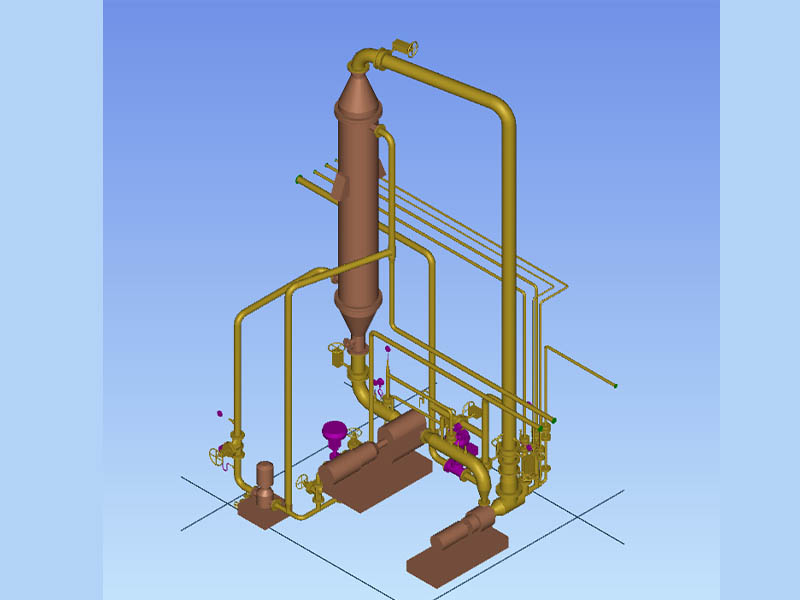
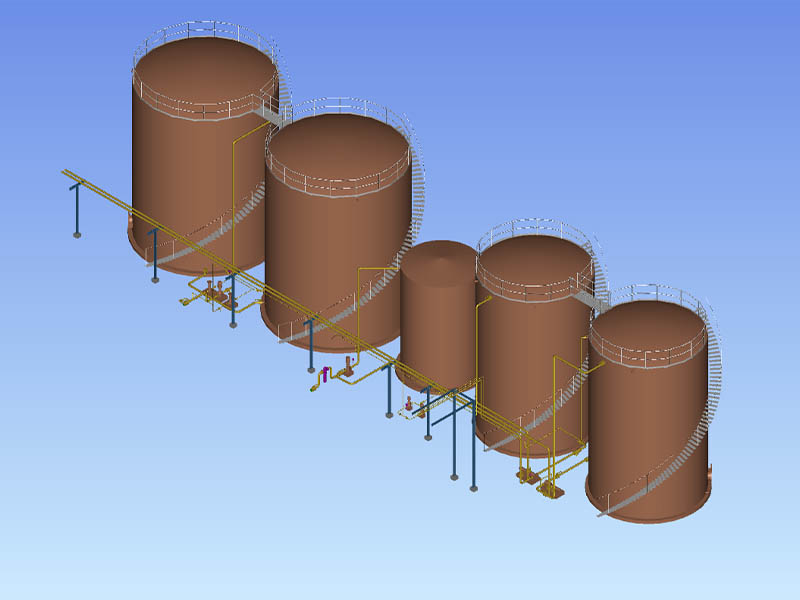
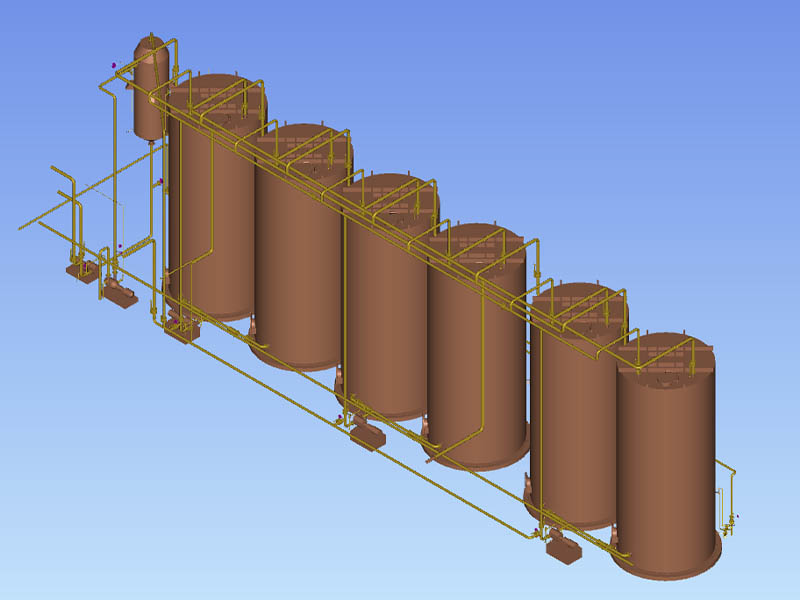
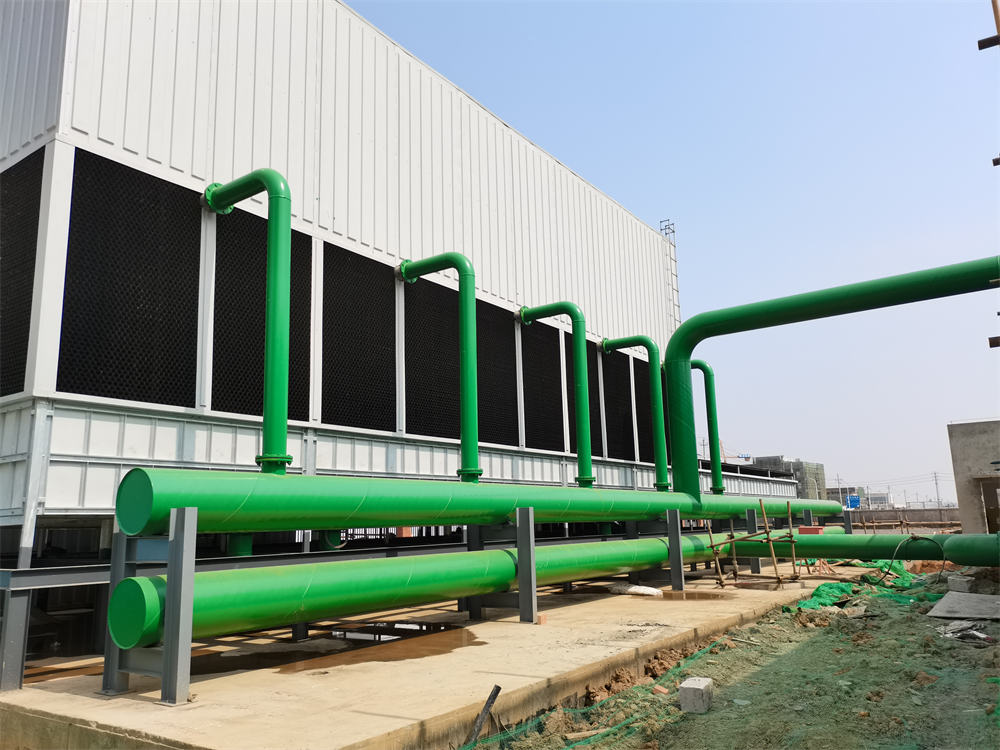
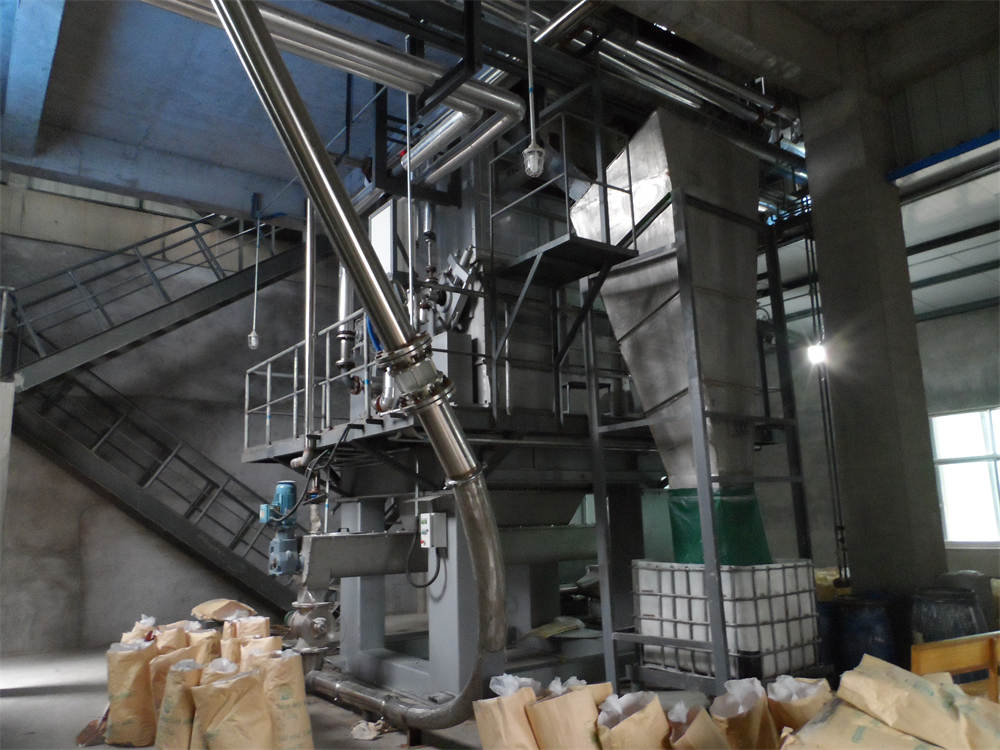
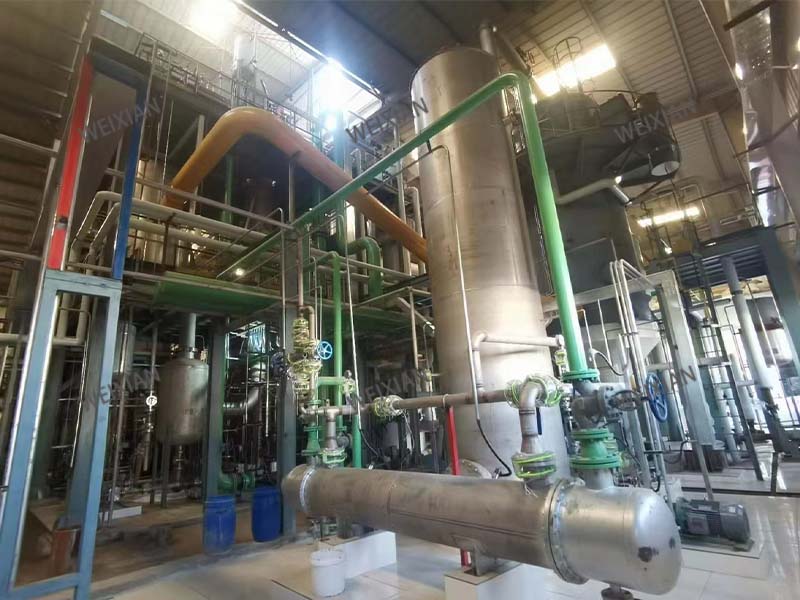
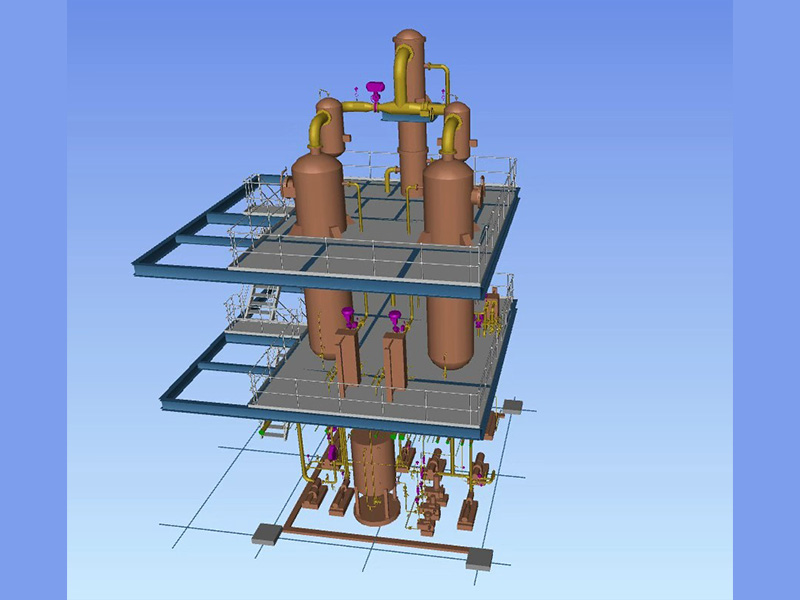
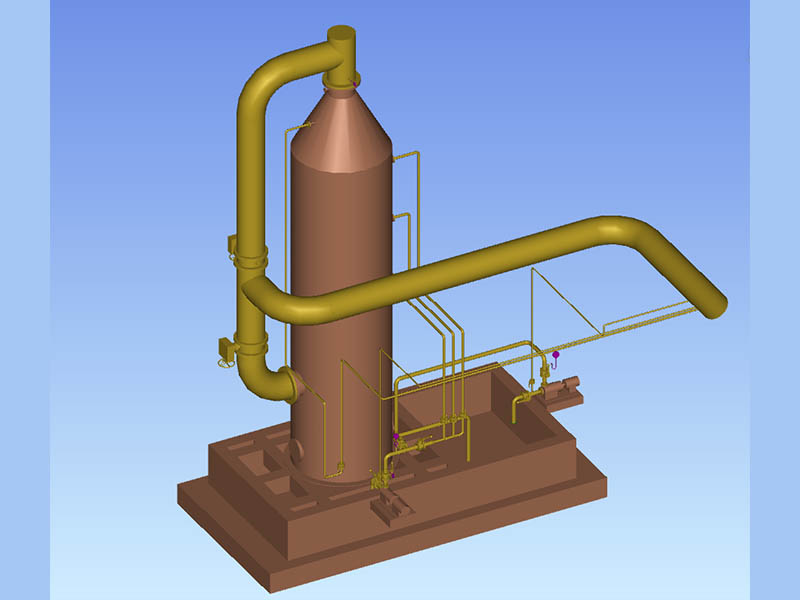
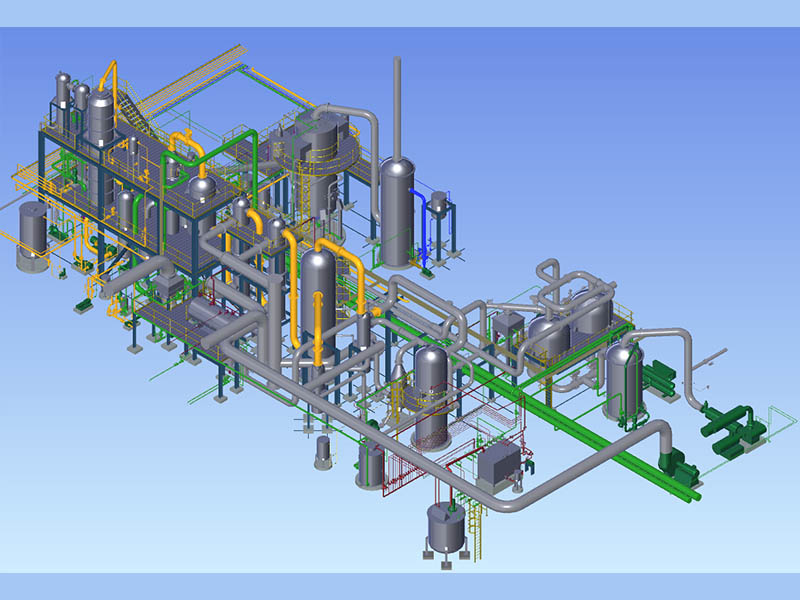
Normally, in the LABSA field, there are two tanks of alkylbenzene (LAB) material tanks, two LABSA tanks and one liquid caustic soda tank, and equipped the transfer pumps for material, finished product and liquid caustic soda. If the plant is for producing multiple products, then corresponding tanks and pumps are needed. Such as AEO tanks, SLES tanks, AO tanks, AOS tanks, Fatty alcohol tanks , SLS tanks, etc.
The pH adjustment unit is to stabilize the pH value, homogenize the product and fine-tune the specifications when producing SLES and SLS.
When the finished product enters the adjustment unit and reaches a certain liquid level, the agitator will stir at a constant speed at the set rpm. Generally, this unit is equipped with multiple stirring tanks and works intermittently.
During the operation of the unit, controlling and testing is required to take samples at regular intervals to check parameters such as product neutralization value, pH, free oil, dioxane, color, etc. When the product quality is stabilized, it will be delivered to the tank farm.
In addition, an optional post deaeration system can be added in order to remove excess air bubbles from the adjusted products, resulting in a more transparent and better looking product.
It is consisted of one circulating water basin, water supply pump for circulating water, water treatment system, circulating water filter etc. The circulating water pump outlet pressure is displayed and alarmed intensively by the computer. Circulating water pump A is the main pump, B is assisting pump and its power is 25% of A and only used in summer. This unique design has resolved water supply peak in summer, and also save the power in spring, autumn and winter.
WEIXIAN provides turnkey plant for LABSA-Na, AOS and SLS drying. Depending on the properties and customer’s requirements, we can provide two types of process: film-scraping and spraying. Please contact us for details.
The sulfuric acid plant and sulphonation plant share a common sulfur melting system. After sulfur melting, the sulfur is transported to the sulfur burning furnace through a sulfur pump and burned with dry air. The dry air is dehumidified by 98% sulfuric acid in the drying absorption tower, achieving a dew point of minus 40 degrees. Then, the main blower sends the dry air to the sulfur furnace for combustion.
After combustion, SO2 is converted once through a conversion tower to produce SO3 gas. Afterwards, SO3 is absorbed by 98% sulfuric acid in the primary absorption tower, and the exhaust gas after absorption returns to the secondary conversion. The heat from the primary conversion will be transferred to the exhaust gas from the second conversion, and after the second conversion, the conversion rate can reach 99.98%. Afterwards, SO3 undergoes secondary absorption, and the exhaust gas undergoes alkaline washing in the scrubber before finally being discharged into the atmosphere. In the early stages of start-up, the scrubber will operate at full capacity to absorb a larger amount of sulfur dioxide from the initial start-up. Under normal operation, qualified discharge can be achieved without passing through the scrubber. The exhaust gas can meet the emission standards in any country under any operating conditions.
The process for energy recovery mainly involves using fire-tube boilers to recover the combustion heat generated by sulfur combustion, as well as the reaction heat generated by the first part and secondary conversions of the converter, and generate steam. Steam can be used for sulfur melting in sulfuric acid and sulphonation plants. Meanwhile, a portion of the steam can also be used for lithium bromide refrigeration in sulphonation units. The remaining steam can be used in other nearby unites. The total heat recovery rate will reach over 80%.
In recent years, Weixian has maintained a strong focus on ultra-low dioxane technology. Building on the previous Unit 79 Neutralization and Dioxane Stripping process, Weixian has newly developed the Unit 89 Dioxane Multi-stage Stripping process, which achieves a dioxane removal rate of 65% to 99%, depending on specific needs. With this innovative technology, a dioxane content of less than 1 ppm can be reliably achieved, regardless of the raw material’s EO number or initial dioxane level.
In April 2026, Weixian engineers have successfully commissioned an ultra-low dioxane system in South Korea.
Through meticulous optimization of operating parameters, the system achieved an impressive 88.7% removal efficiency, reducing dioxane concentration from 9.88 ppm to 1.13 ppm. The client is highly satisfied with the results, and further reduction in dioxane levels is achievable upon request.
This breakthrough allows any sulphation plant to comply with the strictest SLES dioxane limits demanded by high-end markets, while keeping costs relatively low.
The hot air generated from the first layer of the converter and SO3 second cooler can be used for silica gel regeneration, extra hot air produces steam and hot water for raw material and finish product heat tracing. Then partial remaining hot air (100℃) further goes to Unit 38 to treat the wastewater coming from the scrubber. Crystal Na2SO4 hydrate will be produced by oxidizing the NaSO3 and Na2SO4, and evaporating water in the wastewater. Therefore, the plant can realize ZERO wastewater discharge from scrubber.
The main reaction heats from the sulfur furnace and the converter generate steam directly by using a fire-tube boiler.
Compared with the traditional technology, this process generates twice steam. Apart from being used in the sulfur melting unit, the steam can fully fulfill the requirement of chilling in air drying unit by replacing the electric driven chiller with steam driven lithium bromide chiller for generating chilling water. The power consumption can be 15% lower.
Patented revolutionary technology. It circulates the system exhaust gas from the ESP outlet to the main process air, raises gas pressure and adds oxygen, then goes through the process of sulfur burning and conversion, sulfonation, and exhaust gas treatment. It manages to reuse the exhaust gas discharged from the ESP, and reduces the exhaust gas discharged to the atmosphere by 96% (meaning only 4% actual emission compared with the traditional process). Meanwhile, this process reduces the caustic soda unit consumption by 7kg on 100% basis, and 2-3kg sulfur.
WEIXIAN sulphonation/sulfonation plants represent the highest level in the industry. So far, we can provide from a one-tube pilot plant to 10t/h mass production plant. Among 200+ projects we have done, the majority of them were turnkey basis, including but not limited to:
· LABSA (sulfonic acid) production line · SLES production line · SLS production line · AOS production line · HABSA production line · MES production line · SLS/AOS/sulfonic acid sodium salt drying units · Other anionic surfactant production lines
By adopting state-of-the-art designs and processes, all the performance aspects including plant reliability, finished product qualities, and unit raw material/power consumption are superior to that of competitive plants.
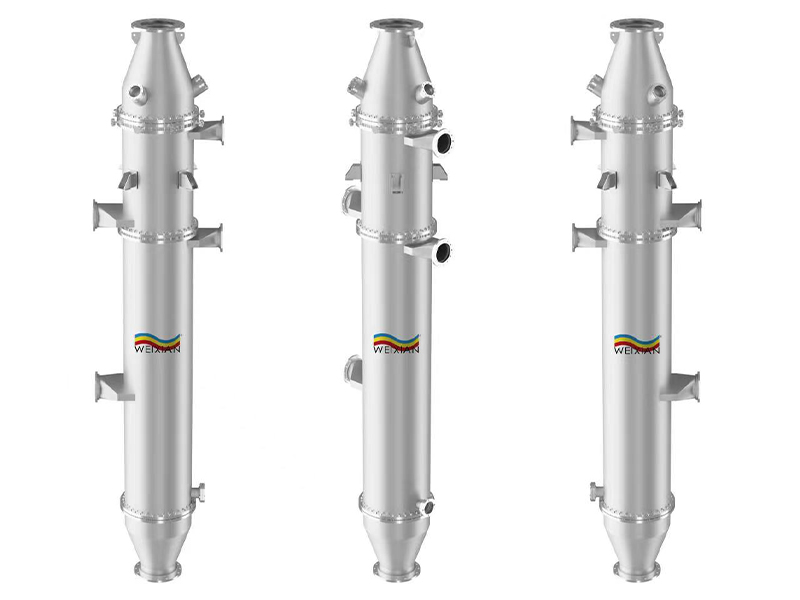
WEIXIAN sulfonator adopts multi-tube falling film reactor. Capacity range is from 1-tube to 240-tube (10t/h). Since 1995, WEIXIAN has supplied hundreds of sulfonators, including 20+ with the capacity over 5t/h. WEIXIAN has successfully applied two world largest 7.5t/h sulfonators in by 2023.
1. Organic material distribution system in the head of reactor
After calibration, the flow deviation reaches ±1.5%. The distribution head and nozzles are one-time clamped processed and formed by a CNC machine to ensure that the tolerance of major dimensions reaches ± 0.005mm, and minor dimensions ± 0.01mm.
2. Finish degree of reaction tube inner wall
Regarding the reaction tubes, high precision cold rolling and annealing are applied, and processed under a 1040℃ vacuum condition to remove inter-molecular stress. Those treatments make sure the inner and outer surfaces’ finish degree of each tube reaches level Ra0.4 (like a mirror); the deviation of the inner and outer diameter of the reaction tube is controlled at less than ± 0.02mm.
3. The welding and flaw detection method of the distribution head and the reaction tube
High-frequency welding + argon arc welding are applied between the distribution head and the reaction tube. The welding form is fillet welding. The flaw detection method is nondestructive testing. For each tube, we applied 0.6Mpa hydrostatic test and endoscopic exploration for weld formation and inner pipe accuracy testing.
4. Concentricity of three tube sheets
All three tube sheets are processed with the same coordinate in the machining center. Tube concentricity tolerance reaches ± 0.01mm. All three tube sheets will be stacked and fixed together according to the installation position and checked each holes by inspection mandrel one by one with concentricity deviation less than ± 0.01mm.
5. Sealing reliability
5.1 The cooling water sealing between the shell side upper section and middle&lower section
The cooling water enters into the second and third parts and exits from the third part of sulfonator. The first (upper) part has to be strictly isolated to ensure the separated circulation of chilling water (15℃), which is crucial for better product quality, especially for AOS.
5.2 The two-way sealing between sulfonator upper part SO3 and organic material
In tube sheet 1, the compressing screw head adopts a combined screw head + three combined gaskets type, which forms a reliable two-way sealing. It realizes 100% isolation of the oleum and prevents rusting and leaking.
5.3 The sealing of cooling water between the distribution head and shell side
Adopting a new type of sealing structure greatly improves the pressure resistance of the shell side. The shell side test pressure can be greater than 0.6Mpa, and the water is able to return with pressure. All sealing parts are made out of special fluororubber O-rings, with 100% sealing efficiency, and lifetime replacement free.
5.4 The sealing of cooling water between the reaction tube’s lower part and the shell side
Applied fluororubber O-rings, the sealing efficiency is 100%, and lifetime replacement free.
6. Other Technical advantages of our sulfonator
6.1 Extended operation period: LABSA continuous production period reaches 40+ days;
6.2 70% SLES continuous production period reaches over 3 months;
6.3 AOS continuous production period reaches 25+ days;
6.4 Easy sulfonator calibration:
First start-up flow deviation is able to reach ±1.5%. The thickness of replacing gaskets are from 1.8~2.2mm (standard thickness is 2mm). Top level products quality and extended sulfonator washing interval can be ensured.
6.5 Yield flexibility:
LABSA capacity adjustment range 55%~115%
70% SLES capacity adjustment range 80%~140%
It adopts the cathode plate hollow-out design to avoid “black acid” accumulation. Cathode SS wires are replaced by SS tubes, in order to eliminate the risk of breaking.
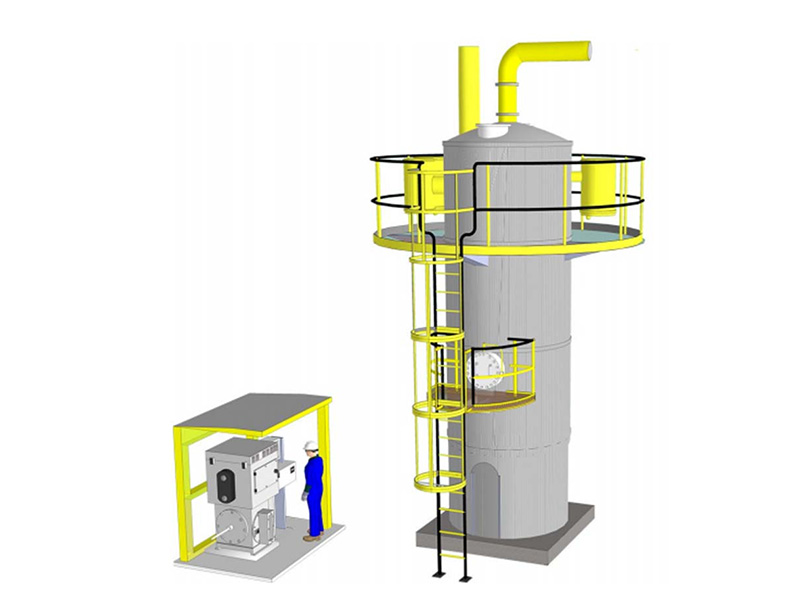
The working voltage is 40,000 V, featured in excellent SO3 and organic acid mists removal performance.
Normally, in the LABSA field, there are two tanks of alkylbenzene (LAB) material tanks, two LABSA tanks and one liquid caustic soda tank, and equipped the transfer pumps for material, finished product and liquid caustic soda. If the plant is for producing multiple products, then corresponding tanks and pumps are needed. Such as AEO tanks, SLES tanks, AO tanks, AOS tanks, Fatty alcohol tanks , SLS tanks, etc.
The pH adjustment unit is to stabilize the pH value, homogenize the product and fine-tune the specifications when producing SLES and SLS.
When the finished product enters the adjustment unit and reaches a certain liquid level, the agitator will stir at a constant speed at the set rpm. Generally, this unit is equipped with multiple stirring tanks and works intermittently.
During the operation of the unit, controlling and testing is required to take samples at regular intervals to check parameters such as product neutralization value, pH, free oil, dioxane, color, etc. When the product quality is stabilized, it will be delivered to the tank farm.
In addition, an optional post deaeration system can be added in order to remove excess air bubbles from the adjusted products, resulting in a more transparent and better looking product.
It is consisted of one circulating water basin, water supply pump for circulating water, water treatment system, circulating water filter etc. The circulating water pump outlet pressure is displayed and alarmed intensively by the computer. Circulating water pump A is the main pump, B is assisting pump and its power is 25% of A and only used in summer. This unique design has resolved water supply peak in summer, and also save the power in spring, autumn and winter.
WEIXIAN provides turnkey plant for LABSA-Na, AOS and SLS drying. Depending on the properties and customer’s requirements, we can provide two types of process: film-scraping and spraying. Please contact us for details.
The sulfuric acid plant and sulphonation plant share a common sulfur melting system. After sulfur melting, the sulfur is transported to the sulfur burning furnace through a sulfur pump and burned with dry air. The dry air is dehumidified by 98% sulfuric acid in the drying absorption tower, achieving a dew point of minus 40 degrees. Then, the main blower sends the dry air to the sulfur furnace for combustion.
After combustion, SO2 is converted once through a conversion tower to produce SO3 gas. Afterwards, SO3 is absorbed by 98% sulfuric acid in the primary absorption tower, and the exhaust gas after absorption returns to the secondary conversion. The heat from the primary conversion will be transferred to the exhaust gas from the second conversion, and after the second conversion, the conversion rate can reach 99.98%. Afterwards, SO3 undergoes secondary absorption, and the exhaust gas undergoes alkaline washing in the scrubber before finally being discharged into the atmosphere. In the early stages of start-up, the scrubber will operate at full capacity to absorb a larger amount of sulfur dioxide from the initial start-up. Under normal operation, qualified discharge can be achieved without passing through the scrubber. The exhaust gas can meet the emission standards in any country under any operating conditions.
The process for energy recovery mainly involves using fire-tube boilers to recover the combustion heat generated by sulfur combustion, as well as the reaction heat generated by the first part and secondary conversions of the converter, and generate steam. Steam can be used for sulfur melting in sulfuric acid and sulphonation plants. Meanwhile, a portion of the steam can also be used for lithium bromide refrigeration in sulphonation units. The remaining steam can be used in other nearby unites. The total heat recovery rate will reach over 80%.
In recent years, Weixian has maintained a strong focus on ultra-low dioxane technology. Building on the previous Unit 79 Neutralization and Dioxane Stripping process, Weixian has newly developed the Unit 89 Dioxane Multi-stage Stripping process, which achieves a dioxane removal rate of 65% to 99%, depending on specific needs. With this innovative technology, a dioxane content of less than 1 ppm can be reliably achieved, regardless of the raw material’s EO number or initial dioxane level.
In April 2026, Weixian engineers have successfully commissioned an ultra-low dioxane system in South Korea.
Through meticulous optimization of operating parameters, the system achieved an impressive 88.7% removal efficiency, reducing dioxane concentration from 9.88 ppm to 1.13 ppm. The client is highly satisfied with the results, and further reduction in dioxane levels is achievable upon request.
This breakthrough allows any sulphation plant to comply with the strictest SLES dioxane limits demanded by high-end markets, while keeping costs relatively low.
The hot air generated from the first layer of the converter and SO3 second cooler can be used for silica gel regeneration, extra hot air produces steam and hot water for raw material and finish product heat tracing. Then partial remaining hot air (100℃) further goes to Unit 38 to treat the wastewater coming from the scrubber. Crystal Na2SO4 hydrate will be produced by oxidizing the NaSO3 and Na2SO4, and evaporating water in the wastewater. Therefore, the plant can realize ZERO wastewater discharge from scrubber.
The main reaction heats from the sulfur furnace and the converter generate steam directly by using a fire-tube boiler.
Compared with the traditional technology, this process generates twice steam. Apart from being used in the sulfur melting unit, the steam can fully fulfill the requirement of chilling in air drying unit by replacing the electric driven chiller with steam driven lithium bromide chiller for generating chilling water. The power consumption can be 15% lower.
Patented revolutionary technology. It circulates the system exhaust gas from the ESP outlet to the main process air, raises gas pressure and adds oxygen, then goes through the process of sulfur burning and conversion, sulfonation, and exhaust gas treatment. It manages to reuse the exhaust gas discharged from the ESP, and reduces the exhaust gas discharged to the atmosphere by 96% (meaning only 4% actual emission compared with the traditional process). Meanwhile, this process reduces the caustic soda unit consumption by 7kg on 100% basis, and 2-3kg sulfur.
WEIXIAN sulphonation/sulfonation plants represent the highest level in the industry. So far, we can provide from a one-tube pilot plant to 10t/h mass production plant. Among 200+ projects we have done, the majority of them were turnkey basis, including but not limited to:
· LABSA (sulfonic acid) production line · SLES production line · SLS production line · AOS production line · HABSA production line · MES production line · SLS/AOS/sulfonic acid sodium salt drying units · Other anionic surfactant production lines
By adopting state-of-the-art designs and processes, all the performance aspects including plant reliability, finished product qualities, and unit raw material/power consumption are superior to that of competitive plants.
WEIXIAN sulfonator adopts multi-tube falling film reactor. Capacity range is from 1-tube to 240-tube (10t/h). Since 1995, WEIXIAN has supplied hundreds of sulfonators, including 20+ with the capacity over 5t/h. WEIXIAN has successfully applied two world largest 7.5t/h sulfonators in by 2023.
1. Organic material distribution system in the head of reactor
After calibration, the flow deviation reaches ±1.5%. The distribution head and nozzles are one-time clamped processed and formed by a CNC machine to ensure that the tolerance of major dimensions reaches ± 0.005mm, and minor dimensions ± 0.01mm.
2. Finish degree of reaction tube inner wall
Regarding the reaction tubes, high precision cold rolling and annealing are applied, and processed under a 1040℃ vacuum condition to remove inter-molecular stress. Those treatments make sure the inner and outer surfaces’ finish degree of each tube reaches level Ra0.4 (like a mirror); the deviation of the inner and outer diameter of the reaction tube is controlled at less than ± 0.02mm.
3. The welding and flaw detection method of the distribution head and the reaction tube
High-frequency welding + argon arc welding are applied between the distribution head and the reaction tube. The welding form is fillet welding. The flaw detection method is nondestructive testing. For each tube, we applied 0.6Mpa hydrostatic test and endoscopic exploration for weld formation and inner pipe accuracy testing.
4. Concentricity of three tube sheets
All three tube sheets are processed with the same coordinate in the machining center. Tube concentricity tolerance reaches ± 0.01mm. All three tube sheets will be stacked and fixed together according to the installation position and checked each holes by inspection mandrel one by one with concentricity deviation less than ± 0.01mm.
5. Sealing reliability
5.1 The cooling water sealing between the shell side upper section and middle&lower section
The cooling water enters into the second and third parts and exits from the third part of sulfonator. The first (upper) part has to be strictly isolated to ensure the separated circulation of chilling water (15℃), which is crucial for better product quality, especially for AOS.
5.2 The two-way sealing between sulfonator upper part SO3 and organic material
In tube sheet 1, the compressing screw head adopts a combined screw head + three combined gaskets type, which forms a reliable two-way sealing. It realizes 100% isolation of the oleum and prevents rusting and leaking.
5.3 The sealing of cooling water between the distribution head and shell side
Adopting a new type of sealing structure greatly improves the pressure resistance of the shell side. The shell side test pressure can be greater than 0.6Mpa, and the water is able to return with pressure. All sealing parts are made out of special fluororubber O-rings, with 100% sealing efficiency, and lifetime replacement free.
5.4 The sealing of cooling water between the reaction tube’s lower part and the shell side
Applied fluororubber O-rings, the sealing efficiency is 100%, and lifetime replacement free.
6. Other Technical advantages of our sulfonator
6.1 Extended operation period: LABSA continuous production period reaches 40+ days;
6.2 70% SLES continuous production period reaches over 3 months;
6.3 AOS continuous production period reaches 25+ days;
6.4 Easy sulfonator calibration:
First start-up flow deviation is able to reach ±1.5%. The thickness of replacing gaskets are from 1.8~2.2mm (standard thickness is 2mm). Top level products quality and extended sulfonator washing interval can be ensured.
6.5 Yield flexibility:
LABSA capacity adjustment range 55%~115%
70% SLES capacity adjustment range 80%~140%
It adopts the cathode plate hollow-out design to avoid “black acid” accumulation. Cathode SS wires are replaced by SS tubes, in order to eliminate the risk of breaking.
The working voltage is 40,000 V, featured in excellent SO3 and organic acid mists removal performance.
WEIXIAN is an engineering company specialized in supplying turnkey sulphonation/sulphation plant and it's technology, focusing on the R&D of LABSA, SLES, SLS, AOS, HABSA, MES and other anionic surfactant production technologies.